Tuesday, 1 May 2018

The Women of Patan


For the last few days we have been enjoying some time in Patan and Kathmandu City eating delicious food, drinking good coffee, and meeting many amazing people.

We are staying in the city of Patan, one of the three sister cities in the Kathmandu Valley. It is known for its centuries old neighbourhoods and hundreds of significant temples and palaces. We love staying in this area and watching daily rituals take place. The community is alive with constant lighting of candles, praying, and painting and fixing of hundreds of years old stupas and temples.

Our neighbourhood in Patan 
On our first night back in the city, our friendly host informed us that the Chariot of Rato Machhendranath that had been moving around Patan for the past couple of weeks was going to be pulled by women the following morning. This would be the only time during the month or so long event where women would have the opportunity to pull the chariot. And so we woke up extremely early for us, yet not so early for the people of Patan, at 4:45 am. Our midwife friend Rashmi, who lives in this neighbourhood, guided us through the narrow, already buzzing streets of Patan to the square where hundreds were gathered, including hundreds of women already lined up to pull the chariot.

Cathy and Rashmi 

It is believed that this chariot festival has been around since the 11th century. Rato Machhendranath is the deity of rain. The idea behind the chariot festival is to move this massive 60-foot chariot throughout Patan during April-May. The festival is conducted before monsoon season to ensure a plentiful rainy season for the local crops. We witnessed true women power. Hundreds of women pulled on massive ropes, dragging the leaning chariot for over an hour. Following this scene of women power, heavy rain poured down into the city of Patan for over an hour.

The Candle Lit Walk for Buddha's Birthday

The following day was spent organizing and presenting the idea of Group Antenatal Care to nurses at a local hospital in Kathmandu. This was one of the activities MIDSON, the association of midwives in Nepal asked us to put on.

We wanted to go for a quick walk before dinner to unwind from the busy day. Our short walk turned into a cultural adventure when we met some women who were participating in a candle- lit walk. We were at Patan Durbar Square when we noticed dozens of women in groupings of different matching saris, lining up with unlit candles in their hands. Seeing all of the colourful saris and hearing the joyful buzz of women, we knew we had to find out what was happening. We sat next to a young woman in a bright pink sari embroidered with intricate geometric patterns and flowers. She shared with me that the women were different women's groups from throughout Patan, coming together for a candle-lit walk on the eve of Buddha's birthday. She explained the plan was to walk for about 45 minutes to different important Buddhist sites throughout Patan before all joining together for an organized program. She kindly invited us to join, and we just couldn't say no. Before we knew it we were wearing paper pins and walking with hundreds of women with candles in hand.


We spent the walk talking to this woman and her family and friends who were a part of this one women's group. She is a social worker who is passionate about sexual and reproductive health. She advocates for and teaches family planning, safe abortion care, and sexual health. We felt so privileged to be walking with such strong women. The walk was incredibly well organized with some of the best traffic control we have seen since being in Nepal. It was thrilling to have hundreds of women stopping traffic!


Although women are still discriminated against and viewed as lower status than men in this country, we have seen how strong and powerful the women are. We cannot begin to describe how grateful we are to all of the women who have welcomed us and shared with is these rituals, stories, and kindness.


A busy last day on the ward in Baglung

April 23, 2018

On our last day at the Dhaulagiri Zonal Hospital we went in at 6 am because the nurse on night shift had called us to say that a woman was in labour. When we arrived there were two women in labour. One was in active labour and the other was still in the latent phase of an induction using misoprostol for cervical ripening. The protocol they use here is 25 mpg vaginally (PV) every 4 to 6 hours up to 4 doses. The nurses I spoke to said that most women will be in labour after the second dose.

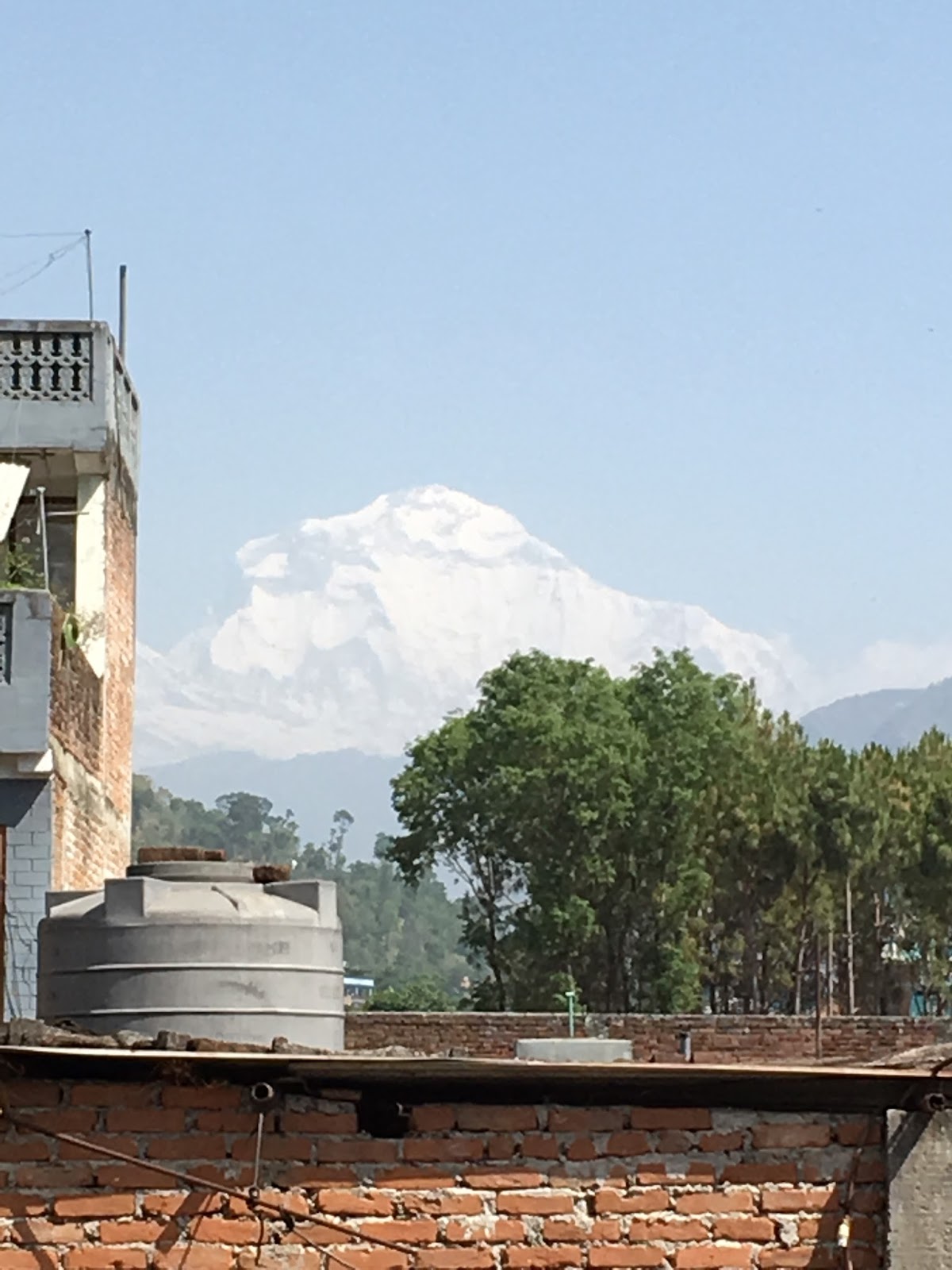
The gorgeous view of Mt. Dhaulagiri from the hospital in Baglung

Our plan for our last day on the ward was to pair up with an SBA and do 4-handed deliveries with them. We were excited to continue working closely with these SBA students who had been a part of our refresher workshop.

When the woman who was in active labour went into the delivery room Emma and Cathy went with her. When her membranes ruptured there was meconium present so we made sure to prepare the warmer in case we needed to resuscitate the baby.


The mother and was coping very well and together with the nurses we moved her onto side lying position to deliver her baby. It was a bit awkward conducting a four handed catch for the first time in the role of the teacher. She easily delivered a healthy baby girl with a nuchal cord. The baby was vigorous and the exhausted mother relieved.

Jenny stayed in the delivery room to monitor the two women in labour. One of the women had arrived while we were taking the first women over to the delivery room. We had seen her every day for the past two days and she arrived in what appeared to be active labour. As we knew the doctor was coming in and would likely perform a vaginal exam on all of the women, we had not examined her. When the doctor examined her she was fully dilated and the baby's head was on the perineum. We moved over to the delivery suite where Emma was suturing her client.

Although she was fully dilated she was not having strong enough contractions to push well, so the decision was made to hang an IV with 5 IU oxytocin in it to give her stronger contractions. We ruptured the membranes and there was meconium present so one of the nurses brought the suction machine over to bedside.


She delivered very slowly with the support of Jenny and an SBA. The baby appeared to be undernourished and of a gestation age that was not concordant with the dates on the mother's antenatal record. We kept the baby skin to skin for a short time and then she was moved to the warmer for a closer look.


Once we got both mother's settled in the postpartum ward we had a quick cup of milk tea and some biscuits. They were delicious!

Our day finished with a difficult cesarean delivery. The woman had been labouring quietly all day with some support from family members, as our team were busy supporting other birthing women. Unfortunately after being in labour all day, and reaching full dilation, her baby's head never descended. In addition to this there was thick meconium when her membranes ruptured. Meconium can be a sign of fetal distress or fetal maturity in addition to putting babies at risk of meconium aspiration syndrome.

The obstetrician assessed her and decided it was time to deliver via cesarean section. Cathy and Emma went into the OT to continue supporting the mother and to resuscitate the baby as needed. It was a difficult delivery for the doctors involved due to lack of resources and maternal health. After several hours in the OT a vigorous, healthy baby was born and we were all relieved. Emma felt very privileged to have the opportunity to witness the skill and patience of care providers working in low resource settings. Both mother and baby are thriving.


Shoulder Dystocia and Student Nurses

April 21, 2018
This post is late as we did not have good enough bandwidth to access the blog while in Baglung.

On this day we started off our morning with two women in labour. One was being induced with oxytocin and one had been transferred from another community to give birth. We were excited to catch some babies. The local obstetrician was called in to assess both women and one was taken to the operating theatre for an emergency cesarean section. Both mom and baby were well.


The other women progressed quickly and soon was pushing. She was supported by two women and was coping well. Here they keep the women in the labour room until the head is visible on the perineum. The woman was standing and pushing fully dressed and it was difficult to assess her progress as we could not see what was happening.
labour ward

After some time we moved to the delivery room. Together with Cathy we practiced slow delivery of the head over many contractions. There were many SBAs and student nurses in the room watching. It is so very different from what we are used to in BC.

delivery room


The baby's head came very slowly so we knew we should be prepared for a shoulder dystocia as the baby also appeared that it may be larger than average by the size of the mother's abdomen and the slow descent of the head.
This is on the wall of the delivery room

Once the head was born we checked for a nuchal cord (cord around the neck) and there was one. We also moved the mother from lying on her side to her back because we were anticipating needing to perform some manouvers for resolve shoulder dystocia.

We flattened the bed and put mother into McRoberts position to open the pelvic outlet, followed by Rubin's to reduce the anterior shoulder.
Image result for mcroberts maneuver

See Perinatal Services BC guidelines for shoulder dystocia.

Baby was born and was placed on mother's abdomen and dried and stimulated. We left baby skin to skin while we waited for the placenta to be delivered. Both mom and babe were well when we got them settled in the postpartum ward.

In the afternoon we hosted a video session for the nursing students. After working with them through a difficult birth it felt good to get together for an evening of fun. They are in their third and final year of nursing school. They have been so helpful to us while we have been in Baglung. We had so much fun sharing some videos from the Global Health Media Project about giving good care in labour, immediate care of the newborn, keeping baby warm, and initiation of breastfeeding. We also demonstrated different positions for labour and pushing along with some comfort methods. It was so much fun to share and practice with them.


Sunday, 22 April 2018

Midwifery Refresher and Respectful Care Update Course

April 19th and 20th we helped Cathy and Micky, facilitate the Midwifery Refresher Course for nurses from Dhaulagiri Zonal Hospital and newly trained SBAs (skilled birth attendants) from rural and remote areas of Nepal. Two MIDSON trainers, Amala and Asha, were also facilitating as well as the departing head nurse and one of the SBA trainers. It was great to have a local expert, Debi teach the condom tapenade, a life saving procedure that can be used to treat Post Partum Haemorrhages that are unresponsive to medications. This is similar to the bakri balloon that can be used in the same circumstances.
The condom tapenade station. 


The topics covered in the course were:


  • Respectful childbirth
  • Slow delivery of the head
  • How to use the somersault maneuver for a nuchal cord
  • Comfort measures and positions for labour and delivery
  • Breech delivery
  • PPH
  • Hypertension
  • Pre-eclampsia
  • Condom Tapenade
  • MVA (Manual Vacum Aspiration for incomplete miscarriage, retained products postpartum and comprehensive abortion care)
  • Helping Babies Breathe
  • Immediate care of the newborn emphasizing skin to skin and breastfeeding in first hour


On the morning of the second day, two of the nurses shared with us that they conducted two deliveries last night using slow delivery of the head with no tears. They were so happy and giddy while explaining the two births to us. This is so exciting to us because it is still routine to give all women an episiotomy during childbirth, especially nulliparous women. We are hopeful that these three young nurses will change the face of care in their hospital.

There was time on both days for presentations on respectful treatment of women in general and also in the childbearing years.


The respectful childbirth presentation by MIDSON was especially important as in Nepal women have few choices during childbirth. For example they are not given the option to have a labour companion or partner in the delivery room or choice of positions. Stories abound in Nepal of women being physically and verbally abused during childbirth.

The nurses and SBAs were keen participants. We enjoyed laughing and learning together with them.
We taught slow delivery of the head, comfort measures and positions for labour and delivery, how to use the somersault maneuver for a nuchal cord, and Immediate care of the newborn emphasizing skin to skin and breastfeeding in first hour. By the end of the day the two of us had birthed dozens of babies through our birthing pants!

Mickey and Cathy presented each of the SBA's with the book "Where Women Have No Doctor" in the Nepali language. This book has been translated into many languages and given to people providing care to women all over the world with limited resources. These books are written by the Hisperian Foundation. To learn more check out their website: http://hesperian.org/


We wrapped up the two day workshop with a short little dance party and photoshoot. We played the song Sisters by a Tribe Called Red and invited the participants to dance with us. This song was chosen by the Canadian Association of Midwives as the song to dance to this year on International Day of the Midwife, on May 5th.

The SBA's and nurses wrote these ideas about respectful childbirth. 

Tuesday, 17 April 2018

Babies in Baglung

Babies in Baglung


We arrived in Baglung on Friday Feb. 13th by jeep from Pokhara. We first had to fly from Kathmandu to Pokhara. The journey in the jeep was a very scenic adventure up into the mountains along a partially completed road. 


We are working at Dhaulagiri Zonal Hospital, a public hospital in Baglung that serves a population of about 60,000, in addition to the surrounding villages. The head nurse of the hospital is a woman with a Bachelor of Nursing who will be leaving for Kathmandu soon to complete her Masters of Public Health. She has been working and collaborating with Cathy and UBC for several years. Her knowledge of the culture, health care system, and translation skills are invaluable.  Auxillary nurses are the ones working the maternity ward. Some but not all have Skilled Birth Attendant (SBA) training. The ward is also buzzing with 6-10 nursing students each shift, and 2 or more SBA students. The nursing students are very young, around 18-19yrs old. It can be quite overwhelming to have everyone in the room during delivery, but it is also wonderful to have so many hands and skills. 


Mount Dhaulagiri from the roof of our hotel


Day 1

We had an interesting first day on the ward. Cathy asked us to set some goals for ourselves and the list below is what Emma and I decided on:
  • Learn how to document in WHO Modified Partograph

  • Using the fetoscope
  • getting to know the staff 
  • learning some Nepali words and short sentences
  • Learning how to apply clorhexadine to the umbilical cord


At 10 am a woman arrived in labour. She was pregnant with her 8th baby. We were surprised to learn that having many children is something that is frowned upon here. Nepal has worked hard to encourage family planning and many families are choosing to have only two children. However women from rural and remote areas, and/or women living in poverty are more likely to have more children as they may not have access to or information about family planning methods. This mother gave birth quickly and easily to a baby girl. The baby was born on the Nepali New Year and in the caul [in the sac of waters] both which are lucky events.

The maternity ward has two beds in the entry hall for women who are not yet in active labour. There are three beds in the ward room for women who are in active labour, being assessed, or being induced. A partition divides the ward room in half. On the other side or the partition is the delivery room. There are two metal delivery tables in the delivery room. There is also a warmer and cupboards with the supplies needed for birth.

Emma and I worked hard to hone our fetoscope skills. We are learning how to listen for the fetal heart rate with a great deal of background noise. Our ears are getting better every day.

Day 2

The morning was busy with women from Baglung and surrounding villages arriving for antenatal check-ups. Some were post-dates, others were in pre-labour. It was a great opportunity to practice our fetoscope skills and palpation skills, in addition to learning some of the hospital protocols.


After lunch we spent time practicing Nepali with the nursing students. We had just finished joking about how we would love a woman to arrive at 8cm, when voila, a woman arrived fully dilated. Continuing with some of the teaching about labour support we had done the first day, we worked with the student nurses to provide kind labour support. The nursing students helped us to comfort the client through Nepali phrases such as: ramro garnu bahyo ("you are doing well") and lamo sas phernus ("breathe deeply").

As we assessed her it became clear that her contractions were not adequate enough for pushing. After augmenting her contractions with a little bit of oxytocin she easily delivered a healthy 2.75kg baby boy. The babies are much smaller on average than babies in Canada. The average birth weight in Nepal is about 2.8kg, and the average birth weight in Canada is 3.4kg. Similarly, people here are smaller on average than people in Canada. The women here are so incredibly strong, with no pharmaceutical options for pain relief, they easily and courageously push their babies out.


Day 3:

Our Goals for Day 3:

Deliver babies using slow delivery of the head
Site IVs
Discuss cases in terms of how we managed them here and how we would manage them in Canada.
Continue to practice our Nepali.
Prepare handouts for Midwifery Refresher and Respectful Care update course April 19 and 20th


We arrived on the ward at 9 am. We discovered that two women had given birth in the night and early morning. We checked on the baby that Emma delivered the day before. Both mom and babe were doing well. We practiced our Nepali with the nursing students who have been very helpful in many ways: showing us how to wash the cord with clorahexadine, how to hang an IV, translating for us, and teaching us more Nepali words and phrases to use with the women.

A young nulliparous (first pregnancy) woman arrived at 10. She had been seen earlier and was 4 cm dilated and appeared to be in active labour. We introduced ourselves and read her chart.

She had a number of women with her who we discovered were her relatives. They were doing such a great job providing labour support. She was very shy and preferred labouring in the stairwell because it provided her with  more privacy. She would come back to the maternity ward so we could check the fetal heart rate. According to the partograph her labour was not progressing quickly enough so the decision was made to augment her labour with IV oxytocin. Her labour progressed rapidly and she gave birth to a healthy baby boy. Cathy supported Jenny through slow delivery of the head.

It was so quiet in the delivery room as she pushed. There were a number of nursing students in addition to Cathy, myself and Emma, and the nurse and everyone was very respectful and quiet. It was a nice change from my first birth where there was lots of background noise and chatter. I think we were able to effectively model respectful childbirth practices.

We walked her over to the postpartum ward with her baby and helped her with breastfeeding.

Dhaulagiri Zonal Hospital

A second young nulliparous woman presented on the ward at about 16:00 in active labour. She too was supported by a number of women. It was so lovely to see how well supported she was. Her labour progressed quickly and soon she was pushing gently. In Nepal they anticipate birth of the baby within one hour of pushing. If a woman has been pushing for more than one hour the nurses consult with the doctor as it is considered a delayed second stage of labour. We consulted with the doctor and he came in. He was very lovely and agreed that she was having a delayed second stage and that we should get baby out but he encouraged us to continue what we were doing and told Cathy he was just here "to support us [the whole team]." The woman gave birth to a heathy baby and Emma caught her second baby in Nepal. We got mom and baby settled in the postpartum ward and went home for dinner. It was a long but good day.

Wednesday, 11 April 2018

Parpopakar Maternity and Women's Hospital

Today we went for a tour at Parpopakar Maternity and Women's Hospital (Thapathali Maternity Hospital) in Kathmandu. It is the only public national referral hospital in Nepal. The hospital was severely damaged in the earthquake and the matrons were quick to point out that the wards they were showing us are only temporary until the new hospital building is finished. Funding for the new hospital campus has come from jhpiego.


In our new Kurti uniforms in front of Patan Dokha near our hotel. 
We did not take any pictures in the hospital, as we wanted to respect the women's privacy.

We had tea with the matrons and read the hospital report from 2016.  Then they took us to see the midwife-led birth centre. They have worked hard to implement protecting birthing women's privacy by hanging curtains around the cubicles in which the women give birth. There are 4 cubicles in the room. The midwives also work to encourage the husbands to accompany their wives and to provide comfort measures. If the husband cannot or does not want to be there then the woman can bring her mother, mother-in-law, or another companion.

We had the opportunity to see their record book where they enter all of the information about each women birthing that day. It was interesting to see that the average newborn weight was about 2800g. Their PPH rate is also very low because each woman is given 10 IU of oxytocin when the baby is born. Unlike in Canada, episiotomies are performed on most of the women. We briefly discussed avoiding episiotomy by promoting slow delivery of the head but it takes a long time for practice standards to change as we well know.

We also went to the nurse-led birthing unit. A woman had just delivered twins vaginally. The baby girls weighed 2400g and 2700g. All three were well. We were introduced to some nursing students who were 15-17 years old.

We continued on to the post-natal ward for post-cesarean recovery. The women stay in the ward for 4-5 days. There were 20 beds in each ward room. There is no separation between beds so little privacy. What we noticed was that  the women were from many different ethnic groups, due to this being a public referral centre. The rooms were very colourful as the women bring their own blankets for their stay.

We stopped briefly at the antenatal clinic and were introduced to some midwifery students but we chose not to observe as we wanted to respect the privacy of the women as well as the students.

Our overall impression was that the wards were clean and well organized. The midwives and nurses were very keen to show us their equipment and set up. They do a lot with much less than we are used to in BC hospitals.


Monday, 9 April 2018

Namo Buddha

Saturday we took a rest day and arranged to go to Namo Buddha, a sacred buddhist site and monastery about 40 km from Patan. We arranged for Tony to drive us there and for Khadga, a local guide, to accompany us.

We left early in the morning to avoid the "the rush" or morning traffic. It still took us 2 hours to drive there. It was a nice treat to get out of the city and into the fresher air of the hills.

It was raining as we left Kathmandu but it soon cleared up. We drove past the newly erected 144 foot tall statue of Shiva. You can see it in the photo below.


Once we got to the original shrine we stopped for milk tea or dudh chai. The woman also sold homemade wine.


The stupa is beautiful.


After we spun the prayer wheels we walked up the steep steps to the monastery.


It was a bit hazy at the top but still stunning.


We saw the cave where Buddha in his previous form is said to have sacrificed his flesh to feed a starving tiger and her cubs.


We left the monastery and walked down to meet Tony. It was lovely to see the countryside. Along the way we came across a large family picnic. The women were dancing together as we walked by. They insisted we join them and we did. We had so much fun!